360° Cancer Care: Well-being at Home Completes Surgical Success
Comprehensive oncology support focused on patient comfort and recovery at home following clinical surgical procedures.
By Pauline Machado
Receiving a cancer diagnosis for a pet is a great challenge, but modern oncology teaches us that this is the beginning of a journey of care. Today, the focus is not only on treating the disease, but on ensuring that the animal goes through the entire process with maximum comfort and minimum stress possible. Surgery is a fundamental step, but the true recovery happens day-to-day, at home, where affection and proper management make all the difference.
In this care we call "360°," protecting the scar is a priority. That's why the use of post-surgical recovery suits is so important: it acts as a protective barrier that prevents the pet from licking or messing with the stitches. Unlike rigid collars that tend to make animals agitated and limit their movements, the suit allows them to continue eating, sleeping, and moving naturally, which greatly helps maintain calmness during healing.
By choosing solutions that bring comfort, such as these protective suits, we transform the post-operative period into a much more peaceful time for the family and the patient. This cycle of care, which begins in the clinic and continues in the comfort of home, ensures that the pet recovers safely and with dignity. After all, protecting the operated area without causing stress is the best way to return the bond and love our companions dedicate to us.
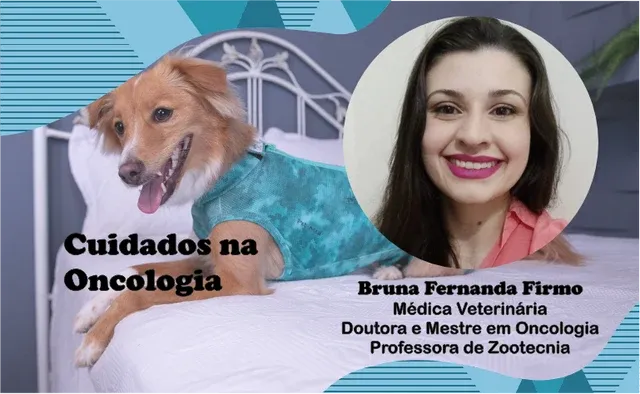
To discuss the topic with us, we invited veterinary doctor Bruna Fernanda Firmo, Doctor and Master from the Veterinary Surgery Program in the area of Veterinary Oncology – FCAV – UNESP “Júlio de Mesquita Filho” – Jaboticabal Campus / SP, with a specialization in Veterinary Oncology from the Lato Sensu postgraduate program – FAJ/IB – Botucatu / SP. She is also a professor at the Faculty of Veterinary Medicine and Animal Science (FAMEZ) of the Federal University of Mato Grosso do Sul (UFMS) – Campo Grande /MS.
Follow the guidelines and at the end of the reading, share with your friends and family.
The beginning of the journey and the diagnosis
Pet Med - When we talk about cancer in pets, why is the "affection examination," that is, palpating the pet at home, as important as vet visits?
Bruna Fernanda Firmo - The so-called "affection examination" is of great value becauseit allows for the regular observation of abnormalities in the skin and mammary glands, since, often, tumors in dogs and cats are initially detected by their guardians and subsequently taken to the veterinarian for diagnostic investigation and treatment. On the other hand, vet visits may occur annually for vaccine updates, which leads to the late detection of potentially malignant changes. In the context of tumors, early diagnosis directly impacts the prognosis, allowing for less invasive interventions with greater chances of disease control, while the opposite, that is, late diagnosis, compromises the outcome of oncological treatment, reducing the chances of cancer control. Therefore, the frequent affection of the pet guardian can be the detector of changes, which will only be anadvantage when complemented by a clinicalevaluation by a veterinary oncologist.
Pet Med - How can families prepare the home environment and their own emotions after a pet's oncology diagnosis?
Bruna Fernanda Firmo - After the diagnosis, it is essential to structure an environmentpaying attention to the adjustments or restrictions advised by the veterinarian, reducing possible complications of the disease. In general, it is important to keep the environment calm, clean, and comfortable, reducing stressful stimuli and facilitating the pet's rest and recovery.From an emotional point of view, this preparation is equally important, given that theguardiansof pets with cancer have specific needs. They frequently experience anxiety, insecurity, and a need for greater emotional support, which reinforces the importance ofempathy and welcome.In this context, understanding that cancercan be controlled with quality of life and transmitting this information objectively to family membershelps transform the initial impact of the diagnosis into care, security, and hopeIn summary, care begins in the environment, but is consolidated asthe diagnosis is reinterpreted.
Pet Med: Maintaining Quality of Life During Cancer Treatment
Bruna Fernanda Firmo explains that veterinary oncology prioritizes both survival and the patient's well-being. Since pets cannot rationalize their illness, the focus must remain on a pleasant experience through rigorous pain management, nutrition, and minimizing stress.
The challenge of post-operative care and healing in oncological patients.
Why does the skin of an oncology patient heal slower than a healthy animal?
Bruna Fernanda Firmo - Oncological surgery involves the resection of tumor tissue along with a quantity of healthy peritumoraltissue comprising the surgical margin, and consequently, a challenge is created for closing this wound, requiring tension-relieving techniques oreven reconstructive surgery. For this reason, greater attention and care are needed in the post-operative period of these patients, avoiding or minimizing post-surgical complications. Furthermore, the oncology patient may present metabolic and inflammatory changes, immunosuppression, and a compromised nutritional status, which can negatively impact healing, making the skin more susceptible to complications. Finally, oncological treatment can delay tissue healing, such as, for example, antineoplastic chemotherapy.
Pet Med - The danger of licking: What are the real risks of inflammation at this time due to not using a surgical recovery suit?
Bruna Fernanda Firmo - Excessive licking can lead tolocal inflammation, bacterial infection, suture dehiscence, and delayed healing. Saliva contains microorganisms that can contaminate the surgical wound, in addition to mechanical aggression to the tissues by the tongue. In oncology patients, this risk is even more relevant due to the possible reduction of the immunological response both by cancer and by immunosuppressive oncological treatment, such as antineoplastic chemotherapy.
Comfort beyond the "cone"
Pet Med - The Elizabethan collar, also known as the cone, often makes pets depressed or stressed. How does the comfort of a protective suit help the animal's emotional health during recovery, allowing the animal to maintain its routine — such as eating, sleeping, and playing — without the physical limitations of a rigid collar?
Bruna Fernanda Firmo - It is understandable that the Elizabethan collar can causerestricted mobilitydifficulty eating, and, consequently, increased stress. However, we have alternatives such as a more comfortable fabric collar or a protective surgical suit. Nevertheless, this substitution must be agreed upon with the responsible veterinarian, according to the temperament of each patient. This ensures adequate recovery, in a calmer way and with a lower level of stress for both the patient and their guardian
Pet Med - For a pet already facing cancer, can stress lower immunity? How does well-being help the body fight the disease?
Bruna Fernanda Firmo - Yes, chronic stress can lead to the release of cortisol, the famous "stress hormone," which is associated with immunosuppression.In oncology, this is relevant because the immune system plays a role in tumor surveillance. Therefore,reducing stress promotes recovery and response to treatment
Details that make a difference
Pet Med - In oncology, the use of protective suits is not merely aesthetic. How does the choice of breathable and anatomical fabric make a difference in the pet's skin health, preventing dirt from the environment or bacteria from coming into contact with the patient's sensitive skin?
Bruna Fernanda Firmo - Protective suits, in addition to acting as a barrier against environmental contaminants, such as dirt, also serve as protection against the sun, and can be either a physical barrier or have additional UV protection.The choice of appropriate fabrics is important becausebreathable fabrics prevent skin moisture, reducing the risk of infectionas moisture promotes the proliferation of fungi and bacteria on pets' skin. In oncology patients, it is important to remove potential carcinogenic stimuli, such as the sun, in relation to skin cancer, and additionally, the skin may be more vulnerable, making this care even more relevant.Beyond patients with cancer, it is important to talk about how to prevent pets from developing cancer, especially those most susceptible, such as those with light fur and in areas with little hair coverage. Intense sun exposure without protection can stimulate the appearance of skin cancer in animals, just as in humans. Protective clothing and/or sunscreen are recommended for prevention, in addition to avoiding the sun between 10 AM and 4 PM, when the intensity of ultraviolet rays is high.
Pet Med - Many oncology patients lose weight or feel colder. Can the protective suit also serve as a “thermal hug” for these more fragile animals? How and in what way does this make a difference in the day-to-day post-operative period?
Bruna Fernanda Firmo - Yes, especially since many patientsexperience body mass loss, favoring the appearance of pressure sores or bedsores on bony prominences. The suit can act as support, promoting comfort, which fosters well-being
Pet Med - How does the ease of putting on and adjusting the suit help the family member perform daily dressings quickly and without causing pain or fear in the pet?
Bruna Fernanda Firmo - Easy-fit suitsreduce manipulation time, facilitating dressing changes and decreasing pain and stress. Additionally, adjustments in areas of high movement, such as the axillary and inguinal (groin) regions, prevent friction wounds from movement. This improves the guardian's adherence to treatment and reduces negative experiences for the patient
The 360° concept and continuous well-being
Pet Med - What does it mean, in clinical practice, to offer "360° Care" for a cancer patient?
Bruna Fernanda Firmo - In clinical practice, offering "360° Care" for a cancer patientmeanstreating the patient and not just treating the disease. This approach includes, in addition to oncological treatment aimed at cancer control, pain management, nutritional support, and the patient's well-being, including the emotional well-being of the family unit to which the patient belongs. It is an integrative, patient-centered approach in a one-health context
Pet Med - Ensuring your pet's comfort at home boosts confidence in your treatment protocol.
Bruna Fernanda Firmo - Oncological treatment prioritizes the patient's well-being; however, it often requires aggressive treatments to fight cancer. A frequent example is surgical treatment, when it is necessary to remove a functional part or when there is an aesthetic detriment to the animal, such as in limb amputation. However, it is important to understand that the cancer is already affecting that tissue and, in addition to rendering it unusable, causes pain or other consequences. When the guardian perceives that the animal iscomfortable and hasa good quality of life after treatment, the chance of continuing with other stages of the cancer treatment plan increases. Often, testimonials from people who have already gone through this decision-making moment and who, after treatment, noticed that it was better for their pet, can help the pet guardian make a decision with more security and confidence, as there will always be risks.
Pet Med –What legacy does modern oncological management leave us regarding the importance of treating pets with a 360° perspective and the greatest possible comfort?
Bruna Fernanda Firmo - Modern veterinary oncology is moving towards individualized and personalized treatment. In this approach, the veterinarian must consider, in addition to tumor characteristics, factors related to possible comorbidities of the patient (often already elderly) and their guardian.
In conclusion, the main lesson is thattreating cancer in animals is not just fighting tumor cells, but caring for the patient and their family unit.
Pet Med - Finally, if you deem it necessary, use the space below to complement your participation by adding other information you consider important and that were not covered during the interview.
Bruna Fernanda Firmo - To enable veterinarians to establish a truly individualized approach, it is essential that their decision-making is anchored in the assessment of prognostic and predictive factors. Prognostic factors are related to the natural evolution of the disease (such as histological type, tumor grade, clinical staging, presence of metastases, and the patient's general condition), while predictive factors indicate the likelihood of response to certain therapies, guiding the choice of the most appropriate protocol (such as the use of tyrosine kinase inhibitors in antineoplastic chemotherapy). This approach not only allows for estimating survival, but primarily balancing therapeutic efficacy and quality of life. Furthermore, the perception and expectations of the animal guardians also directly influence treatment adherence
An important point is that, as discussed, many oncology patients can live for long periods with a good quality of life when treatment is well-managed.
Family experience
The technical guidance from Dr. Bruna Fernanda Firmo reinforces that the success of modern oncology depends on this careful attention to every detail of postoperative care. This specialized care materializes in the daily lives of those experiencing the recovery routine, consolidating the real impact of '360° Care'.
To illustrate how this theory applies in practice, we spoke with Agnes Granero, guardian of Olivia Palito, a 7-year-old dog who underwent the removal of a cutaneous mastocytoma
Agnes shares how choosing protection that prioritizes comfort — replacing the stress of a rigid cone with the security of a post-surgical garment from Pet Med — transformed a moment of vulnerability into a safe, functional, and much more serene recovery for the entire family. Read the testimony below.
Adaptation in the first few days
Adaptation was very smooth, as she is already used to wearing clothes. The garment helped protect the surgical site, preventing direct access to the operated area and avoiding licking or possible traction on the stitches, which brought more security during recovery. At the same time, it allowed her to maintain her normal routine — going number two, peeing, eating, and resting comfortably ."
Autonomy in daily life
" As a guardian, this brings an enormous sense of relief. Seeing that she was comfortable, showing no discomfort, and able to continue with her daily activities even after surgery brought a lot of peace of mind during the postoperative period.
The garment not only helped protect the wound but also made this time lighter for the whole family because when we see our pet well, active, and without discomfort, the recovery ends up being much more peaceful for everyone ."
Family peace of mind
" She had already used the protective and post-surgical garment from Pet Med when she was spayed, so we already knew that the garment is an item that brings more safety and comfort during this recovery period, and we weren't worried.
The moment of care
" Managing it at home was super easy ; it only lasted 10 days . The garment is easy to put on and take off, which made it easier to check the scar and perform the necessary care without causing stress. In addition, the quick-drying fabric made changes and hygiene much more practical in daily life, keeping the area drier and more comfortable. This brings more security, showing that it's not just a surgical garment, but a product designed to facilitate care during recovery! "
Overall perception
" This choice as part of the post-surgical protocol was very important, because I believe that using the protective garment goes beyond protection. It brings more comfort, quality of life, and well-being to the pet, and with that, it brings more practicality and less worry for the guardian, because we all know that when our pets undergo any surgical procedure, we become anxious, because we want their recovery to be smooth, without any complications ."
Technologies and performance in recovery from surgeries and treatments
Understand the importance of professional care and advanced medical support to ensure effective recovery processes following clinical procedures.